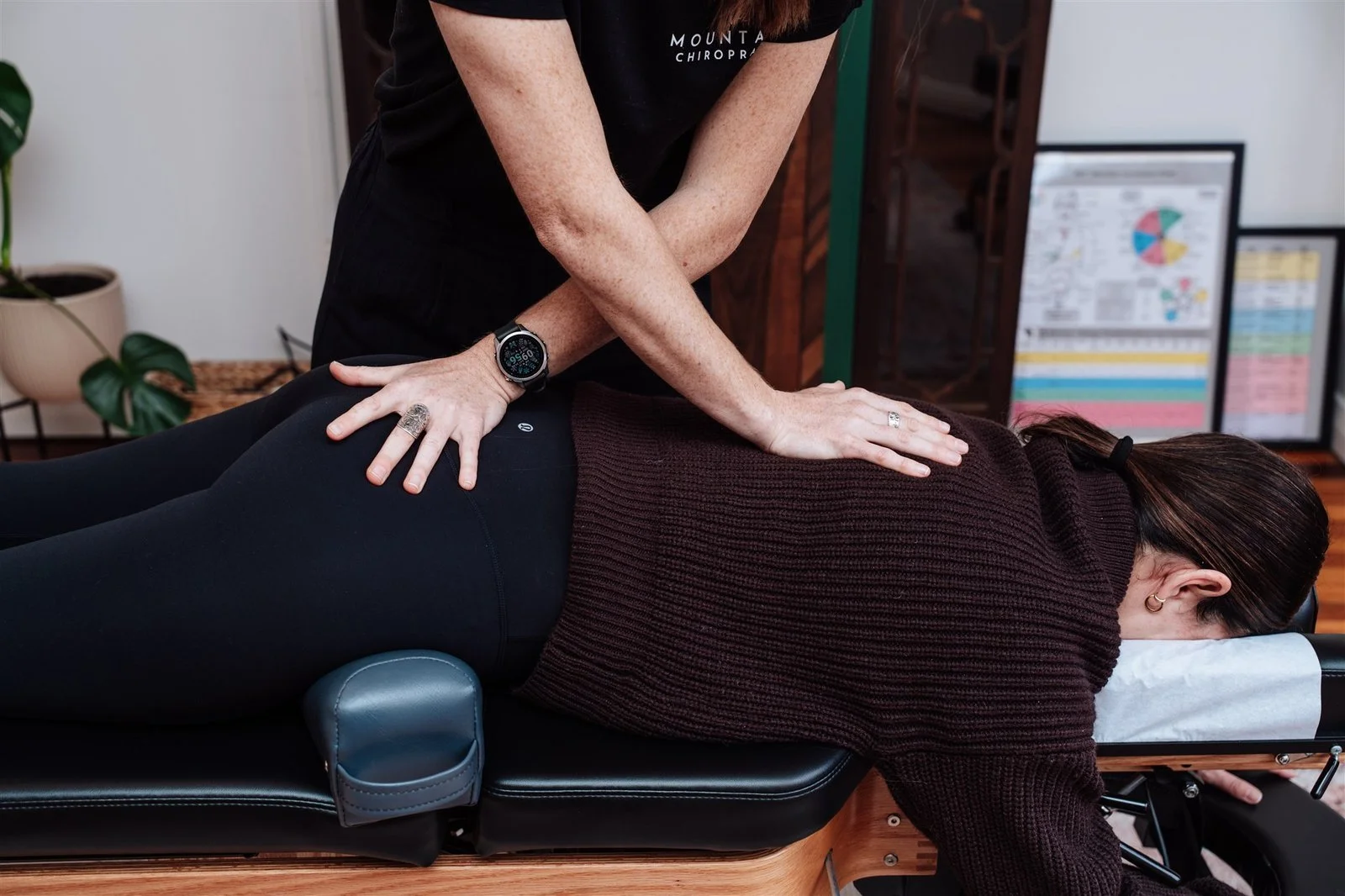
How often you see a chiropractor is best guided by how well your body is functioning, not by whether something hurts this week. For people with recurring back pain, research shows that regular, planned visits lead to fewer days of pain over a year than coming in only when it flares up.
Yes, pain is a good reason to come in, and plenty of people walk through our door for the first time because their back or neck has finally had enough. But "I'll come back when I feel I need it" usually means "I'll come back when it hurts", and by the time it hurts, your body has often been struggling for a while.
We often say pain is the tip of the iceberg. It's the last thing to arrive and the first thing to go. Above the waterline is the sore back, the stiff neck, the headache that builds through the afternoon. Below it is everything your nervous system has been quietly managing (and compensating for) before you noticed a thing. When the pain settles it's tempting to think the job is done, but the bulk of the iceberg is often still sitting there.

Your nervous system runs a huge amount that you never feel: your heart rate, your breathing, your digestion, your blood pressure, how your muscles brace and coordinate, how well you recover from a run or a broken night's sleep, keeping you upright on the train while you're half asleep etc. You don't feel your organs from day to day, and you're not meant to. That's why "I feel fine" isn't the same as "I'm functioning at my best", and why keeping yourself FUNCTIONING at your best means not waiting until you're broken to come in.
What does your nervous system do that you can't feel?
Interoception is the term for how your brain senses what's happening inside your body, or the signals coming in from your organs, blood vessels, muscles and joints. A 2021 review of the neural circuits of interoception notes that most of this processing happens outside conscious awareness. Your brain is reading and adjusting your internal state all day, and very little of it reaches the part of you that notices.
The gap is bigger than most people expect. In a 2025 paper in Neuron, researchers estimated that our sensory systems gather information at around a billion bits per second, while the rate at which we consciously think and act on information is about 10 bits per second. So the share your conscious mind actually works with isn't a few percent. It's closer to one hundred millionth.
Why is pain a poor guide to when you need care?
Pain is an output from your brain, not a direct readout of what's going on in your tissues. The International Association for the Study of Pain makes this point in its 2020 revised definition of pain: pain and nociception (the nerve signals coming from tissues) are different things, and pain can't be inferred from sensory nerve activity alone. Your brain decides when something needs your attention. Until it does, changes in how a joint moves, how your muscles brace or how well you're recovering can build up without you feeling much at all.
Pain often eases well before the pattern underneath it has changed, which is why stopping care the moment you feel better tends to land people back on the table a few months later.
What does the research say about regular care vs coming in when it hurts?
The Nordic Maintenance Care trial (Eklund et al. 2018) followed 328 people across Sweden with recurrent or persistent low back pain, all of whom had clearly improved during an initial course of chiropractic care. Half were booked in for preventive visits at intervals set by their chiropractor (no more than 3 months apart). The other half were told to call when the pain came back. Over 12 months, the scheduled group had on average 12.8 fewer days of bothersome back pain, for an average of 1.7 extra visits (6.7 vs 4.8). The authors point out that adds up to almost a working month.
It's worth knowing who was in this trial. Everyone had already been through an initial course of care and improved clearly before the regular visits began. Maintenance care isn't where you start, it's what comes after your body has responded. The difference also built up slowly: a little less pain most weeks, adding up to nearly a working month's worth of days over the year. And the chiropractors in the trial couldn't book maintenance visits closer than a month apart, which some of them felt held back the patients with more persistent pain.
How often you're adjusted at the start matters too. A 2018 trial of 256 adults with chronic neck-related headaches (Haas et al.) compared being adjusted once, twice or three times a week for 6 weeks, against a light massage (everyone came in 3 times a week, with the massage at the visits where they weren't adjusted). The more often people were adjusted, the fewer headache days they had, and that held at every follow-up to a year. Those adjusted 3 times a week halved their headache days, from about 16 to 8 a month, around 3 fewer a month than the massage group. The researchers couldn't find a point where more adjustments stopped helping. A similar 2014 trial in chronic low back pain found a smaller version of the same pattern, with the most adjustments giving the best results a year later.
So how often should you come in?
We recommend your schedule based on your personal circumstances, but coming in only when you're in pain is like visiting Australia and only going to the Gold Coast.
Alongside care, the things that help your nervous system hold onto that progress are the everyday ones: regular movement and play, sleep, eating well, being social and reducing stress (where possible). None of them are new, but together they decide how much load your body is carrying between visits.
If you'd like to know what's sitting below the waterline for you, this is something we look at in clinic every day, in Blackheath and Bullaburra.

References
Berntson GG, Khalsa SS. Neural circuits of interoception. Trends Neurosci. 2021;44(1):17-28.
Zheng J, Meister M. The unbearable slowness of being: Why do we live at 10 bits/s? Neuron. 2025.
Raja SN, et al. The revised International Association for the Study of Pain definition of pain: concepts, challenges, and compromises. Pain. 2020;161(9):1976-1982.
Eklund A, et al. The Nordic Maintenance Care program. PLoS ONE. 2018;13(9):e0203029.
Haas M, et al. Dose-response and efficacy of spinal manipulation for care of cervicogenic headache. Spine J. 2018;18(10):1741-1754.
Haas M, et al. Dose-response and efficacy of spinal manipulation for care of chronic low back pain. Spine J. 2014;14(7):1106-1116.